Repointing Victorian brickwork, stone carving and more, London home

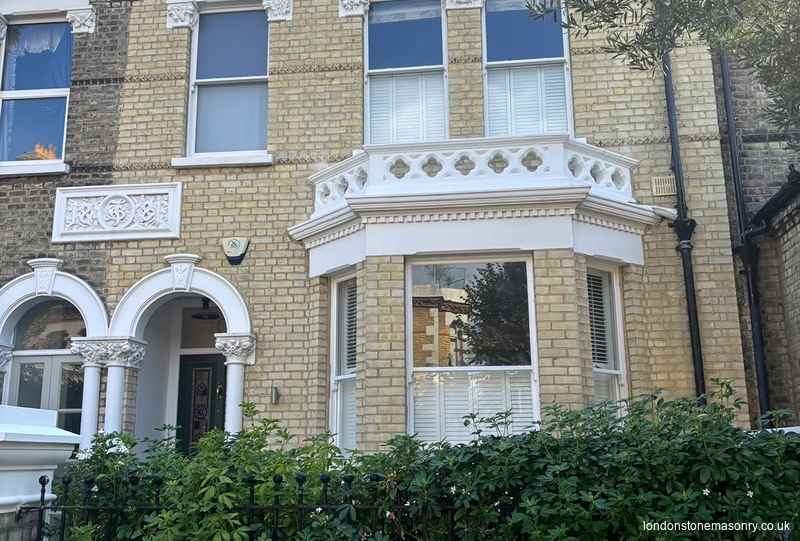
Pictured: London Stonemasonry restored the front of this Victorian house on Brodrick Road, Wandsworth Common SW17
London Stonemasonry repointed a Victorian house on Brodrick Road, Wandsworth Common SW17, raking out the cement pointing and replacing it with lime mortar, pinning cracked stone to the bay parapet and front wall, carving a new letter-carved pier cap and porch column base and more.
The homeowners contacted London Stonemasonry because they wanted to refresh the facade of this beautiful Victorian house.
Brodrick Road sits in the Wandsworth Common Conservation Area, a street of individually styled Victorian houses built between 1850 and 1920 by a number of builders, singly, in pairs and in short terraces, in what the council’s appraisal calls “a village on the common”. This house is typical of the best of them: three storeys of yellow stock brick with a pierced quatrefoil parapet over the ground-floor bay, a dentil cornice, bands of dogtooth brick and a shared round-arched porch with carved foliate capitals.
A before and after image: The new bespoke stone pier cap


Pictured: The old cracked gate pier cap and the new letter-carved Thorncross cap by London Stonemasonry
The challenge: Cement pointing on solid wall Victorian brickwork
The property had been previously repointed in cement-based mortar, so one of the main parts of the project was to remove this and replace it in lime mortar.
With solid wall Victorian-era construction, lime mortar would have been used to lay the bricks and should also be used when repointing. Lime lets the wall breathe. Using cement can trap moisture in the brickwork and result in damp issues.
The stonework needed attention as well. There was cracked stone to the bay parapet wall and to the copings of the front wall, and the letter-carved pier cap on the gate and the base of the porch column had worn to the point where new ones had to be carved. Left alone, trapped moisture keeps working at the bricks and stone of a solid wall from the inside, and cracked copings and parapet stone let more water in every winter.

Pictured: Cracked cement pointing in the brick courses between two stone copings on the front wall, before London Stonemasonry raked it out

Pictured: A vertical crack through the front garden wall coping, one of the cracked stones pinned and restored by London Stonemasonry
Our solution: Lime mortar repointing, pinned stone repairs and newly carved stonework
We agreed costs for the restoration and redecoration of the stonework, along with templating and replacing the letter-carved pier cap and the mullion base to the porch. Scaffolding was erected and work began with the removal and replacement of the pointing, followed by pinning and restoring some cracked stone to the bay parapet wall and the copings to the front wall.
Once all repairs were carried out we decorated in Keim breathable masonry paint, which we use on lime-pointed solid walls for the same reason the brickwork needed lime mortar. We had templated the pier cap and the porch column base, and once carved they were installed as the last items, followed by decorating them in Keim paint.

Pictured: A stainless steel threaded bar bedded across a crack in the parapet stone, part of the pinning and restoration by London Stonemasonry
Result: A breathable facade, and the house name back on the gate
The project took four weeks to complete and the owners were delighted with the result.
The front of the house now has lime mortar joints that let the solid brickwork release moisture instead of trapping it, and a Keim finish that breathes with the wall.
The cracked stone on the bay parapet and the front wall copings are pinned and restored. The sills and bay are repaired and repainted, and the replacement bricks sit in the Flemish bond face.
At the gate, the new pier cap carries the house name, Thorncross, cut into the stone, and under the porch the column stands on a crisp new carved base.


Pictured: The front of the house before and after lime repointing, pinned stone repairs and Keim breathable paint, by London Stonemasonry

Pictured: The new carved porch column base in place beside the front door, decorated in Keim paint by London Stonemasonry
Contact us: Restore and repoint your Victorian home
London Stonemasonry is one of London’s leading specialists in lime repointing and carved stone repairs to Victorian houses.
We work on Victorian terraces across London, from bay windows to porches, pier caps and parapets.
If your Victorian house has cement pointing, cracked stone or a worn pier cap, contact us for an itemised costed survey.
You can also read more about our brick and facade restoration service.
Example review: Our facade work is highly recommended
N.L.N., a London homeowner, left this review of our work on the front of their house:
“London Stonemasonry are the best! They renovated the front of our house and it looks great – all brick and stone cleaned, repointed and repaired, with some replacements. Thanks Will and Adam.”
On a similar lime repointing job on Honeywell Road in Clapham SW11, the client was so pleased with the property’s new look that they asked us to repoint the front wall in the matching lime mortar mix and redecorate the railings too.
Frequently asked, and related, questions about this project
See also
Project summary
Facade restoration, including lime repointing and carved stone repairs to a Victorian house on Brodrick Road, Wandsworth Common SW17. Cement pointing raked out and replaced with lime mortar, a new letter-carved pier cap and porch column base and more.